AI Video Greetings: When a Regular Greeting Card Just Isn’t Enough
See how AI can turn an ordinary photo into a fun, personal video greeting for birthdays, holidays, friends and family.
There’s a funny thing about greetings.
Every year there’s another birthday, another holiday, another person you want to congratulate. You open your messenger and start thinking about what to write.
“Happy birthday! Wishing you happiness, health and all the best.”
You send it.
Then you look at the message and realize the person has probably received something very similar ten times already.
There’s nothing wrong with a simple message. Sometimes that’s exactly what someone needs.
But every now and then, you want to send something a little more personal. Something that makes the person stop scrolling for a moment.
That’s where AI video greetings get interesting.
Not because you suddenly need to become a video editor.
Quite the opposite.
You can take a ready-made video, add a photo and turn it into something that feels much more personal than a standard greeting card.
And the result can be surprisingly fun.
Why a video feels different
A picture is easy to scroll past.
You open the message, look at it, read the text and move on.
A video usually gets a few more seconds of attention. You start watching to see what happens.
And when a familiar face appears in the video, there’s an extra moment of recognition.
“Wait. Is that me?”
Or, if you made the video for someone else:
“Is that actually you?”
That little surprise is what makes the format work.
Imagine your friend’s birthday.
You could send a card. You could write a long message. You could record yourself on your phone.
Or you could make a short video where your friend unexpectedly becomes the main character.
It doesn’t have to be serious.
In fact, the funny ones are often the best.
That’s the nice thing about these videos. An ordinary photo suddenly becomes something you can watch, share and keep.
Start with a friend
Friends are probably the easiest people to make these videos for.
You already know what they find funny. You know what kind of video they would actually watch instead of politely replying with a thumbs-up.
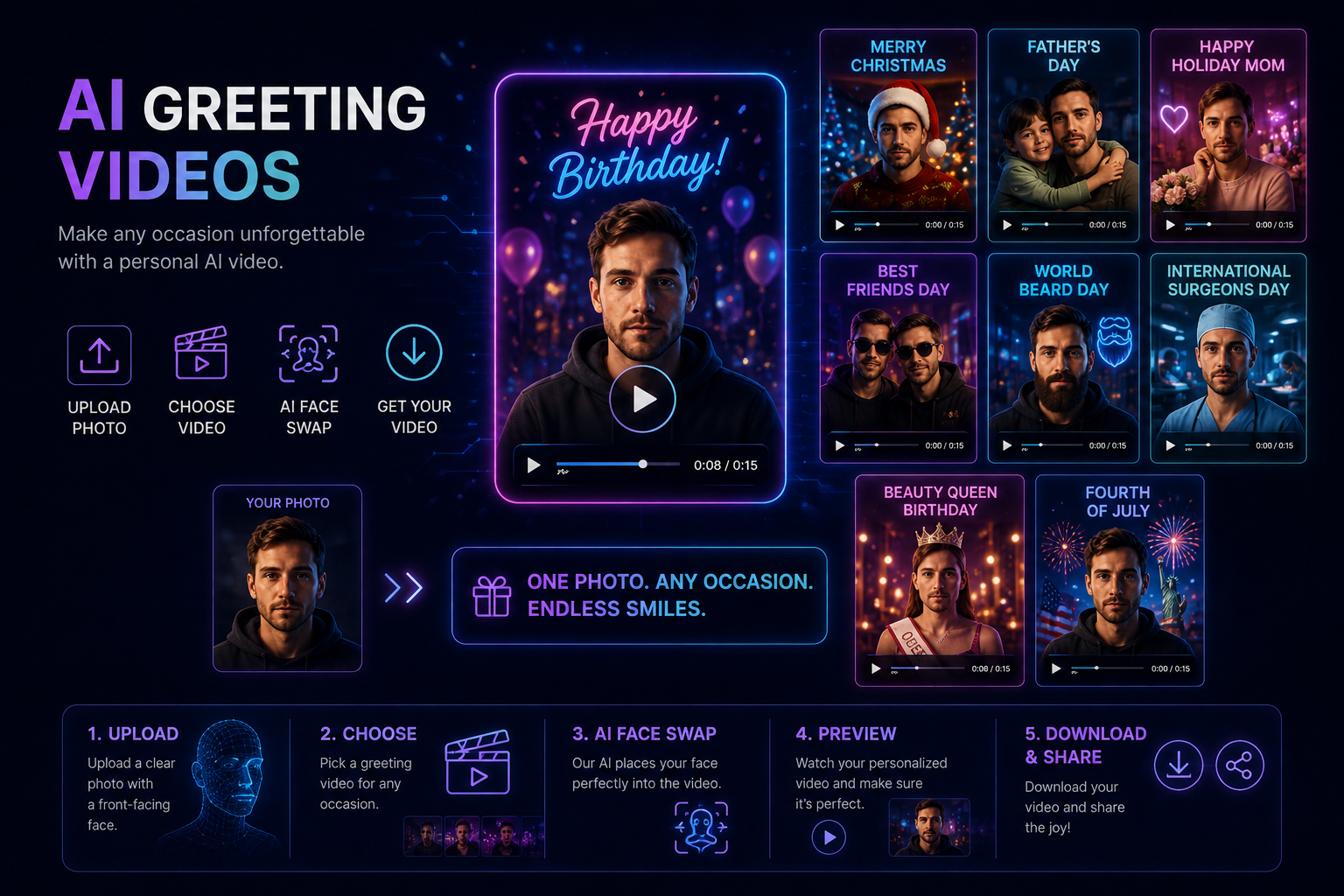
CMEX has a Best Friends Day video greeting built around friendship and the kind of personal surprise that works well between friends.
You can use a photo of your friend.
Or make yourself part of the video.
There isn’t really a complicated rule here.
Pick something that fits the person.
Generate it.
Send it.
Sometimes the entire conversation afterwards is just:
“Are you serious? 😂”
Which is actually a pretty good result.
Holidays make things easier
The nice thing about holiday greetings is that you don’t have to invent a reason.
Christmas is coming.
Someone’s birthday is coming.
Father’s Day is on the calendar.
There’s always something.
And while finding a regular holiday card takes about five seconds, a personalized video feels a little less generic.
Take Christmas.
There are endless Christmas images online. Beautiful ones, funny ones, animated ones.
But CMEX also has a Christmas AI video greeting with a proper holiday atmosphere. Add a photo and suddenly you have something made specifically for the person receiving it.
You can send it to family.
A friend.
A colleague.
Someone you simply want to surprise.
It takes roughly the same amount of effort as sending a picture, but it doesn’t feel quite as disposable.
Some holidays are much more fun than others
There are the obvious holidays.
Then there are the ones that make you stop and think:
“Wait, that’s actually a holiday?”
World Beard Day is a good example.
If your friend has a beard, you already know where this is going.
You could send:
“Happy World Beard Day!”
Or you could make the whole thing a little more ridiculous.
CMEX has a dedicated World Beard Day video for exactly that occasion.
The holiday itself becomes part of the joke.
Congratulating someone on a normal holiday is nice.
Remembering a random day about beards and sending a personalized video is much harder to forget.
Professional greetings can be personal too
Then there are professional holidays.
These can be tricky.
You want to congratulate a colleague or friend, but the standard message can sound like something copied from a company newsletter.
“Congratulations on your professional holiday. Wishing you success in your career.”
Technically fine.
Not exactly memorable.
A video made specifically for the occasion feels different.
For example, CMEX has an International Surgeons Day AI greeting for doctors and surgeons.
Now there’s an obvious reason why you picked that particular video.
And that’s one of the useful things about ready-made templates. You don’t have to invent an idea from scratch every time.
Then there’s Mom
Making a greeting for your mother is a slightly different situation.
You usually want it to feel warm.
You can write a long message.
You can call.
You can send flowers.
Or you can add a small video to the whole thing.
CMEX has a dedicated holiday video for Mom.
There’s no complicated preparation involved. You already have the photo, the video is ready, and you simply put the two together.
It becomes a small gift that can be sent straight through a messenger.
And there’s something nice about the fact that you actually picked something for that particular person instead of grabbing the first greeting card you found online.
Dad is a little different
With dads, you can obviously go sentimental.
But you can also have a little fun.
A Father’s Day video can work particularly well if you want to send something that Dad will actually watch instead of another generic card.
You don’t even need a long message.
“Happy Father’s Day, Dad.”
Then the video.
That’s probably enough.
Birthdays don’t all have to look the same
Birthdays are probably the most obvious reason to make a video greeting.
But even here, you don’t have to pick the first video with “Happy Birthday” written across it.
One person might like something funny.
Someone else might prefer something glamorous.
Someone else would probably appreciate something completely ridiculous.
For example, CMEX has a Beauty Queen birthday video with a more glamorous feel.
It isn’t just another generic birthday message. The whole idea has a particular mood.
And sometimes the mood matters more than the words.
Then you start finding unexpected reasons
There’s a funny thing about having these videos available.
Once you know you can make one, the occasion starts to feel less important.
First you make one for a birthday.
Then Christmas comes around.
Then Father’s Day.
Then you notice some completely random holiday.
Eventually you stop waiting for a date.
You see a video and think:
“That would be perfect for Alex.”
So you make it.
No birthday.
No anniversary.
No particular reason.
Just because it would make them laugh.
Those can actually be the best ones.
International holidays make things even more interesting
If you have friends, relatives or colleagues in different countries, there are even more possibilities.
Take the Fourth of July AI video.
For an American friend or colleague, it’s a very specific occasion. You’re not sending a generic holiday clip. You’re sending something that actually belongs to their calendar.
That’s the nice thing about personalized greetings.
The holiday changes.
The language changes.
The people change.
But the basic idea stays the same: take a familiar face and put it into the right little story.
The video doesn’t have to be perfect
This is worth mentioning because people can get surprisingly picky about AI video.
They pause the clip.
Look at the face.
Watch the movement again.
“Hmm. That frame looks a little strange.”
Sure.
Sometimes it does.
But if you’re making a birthday greeting for a friend, you’re not submitting the video to a visual-effects competition.
You’re trying to make someone smile.
That’s a very different standard.
If the person watches it, laughs and sends you a message, the video worked.
There’s no reason to make it more complicated than that.
You probably already have a good enough photo
Another thing people tend to overthink is the photo.
Which one should I use?
Should I take a new picture?
Do I need perfect lighting?
Probably not.
A normal photo from your phone is often enough to get started.
Obviously, it helps when the face is clearly visible. But you don’t need a professional portrait or a photo shoot.
You can simply open your camera roll and see what’s already there.
An old selfie that has been sitting on your phone for two years suddenly has a reason to exist again.
A photo of a friend becomes a birthday greeting.
A family picture gets turned into a holiday video.
A regular portrait ends up inside a completely unexpected scene.
The best part is that you don’t have to record yourself
This might actually be the biggest advantage.
A lot of people would happily send a personal video greeting if they didn’t have to record one.
Maybe they don’t like being on camera.
Maybe they don’t know what to say.
Maybe they hate hearing their own voice.
Maybe they start recording “Happy Birthday!” ten times because the first nine somehow sounded awkward.
With a ready-made AI video, none of that matters.
You use a photo.
Choose a video.
Generate it.
It’s almost like a greeting card that learned how to move — except the person in the video can actually be the person you’re congratulating.
A greeting doesn’t have to be a competition
You don’t need to create the most original gift anyone has ever seen.
You don’t need a five-minute video.
You don’t need a perfect script.
Sometimes all you need is a photo, the right video and a few minutes.
Find the occasion.
Find something that fits.
Add the photo.
Send it.
Then see what happens.
Maybe the reply is just a laughing emoji.
Maybe you get:
“Where did you get this?”
Maybe they send it to somebody else.
That last one is usually a good sign.
Because that’s really the test of a greeting.
Not how complicated the AI technology was.
Not how many buttons you had to press.
Not how impressive the description of the technology sounds.
Just this:
Did the person watch it and smile?
If they did, then maybe a regular greeting card really wasn’t enough this time.