What AI Face Swap Actually Does
How modern face swaps became so realistic, what happens to a face during AI video generation, and why a simple selfie can now become the starting point for something completely new.
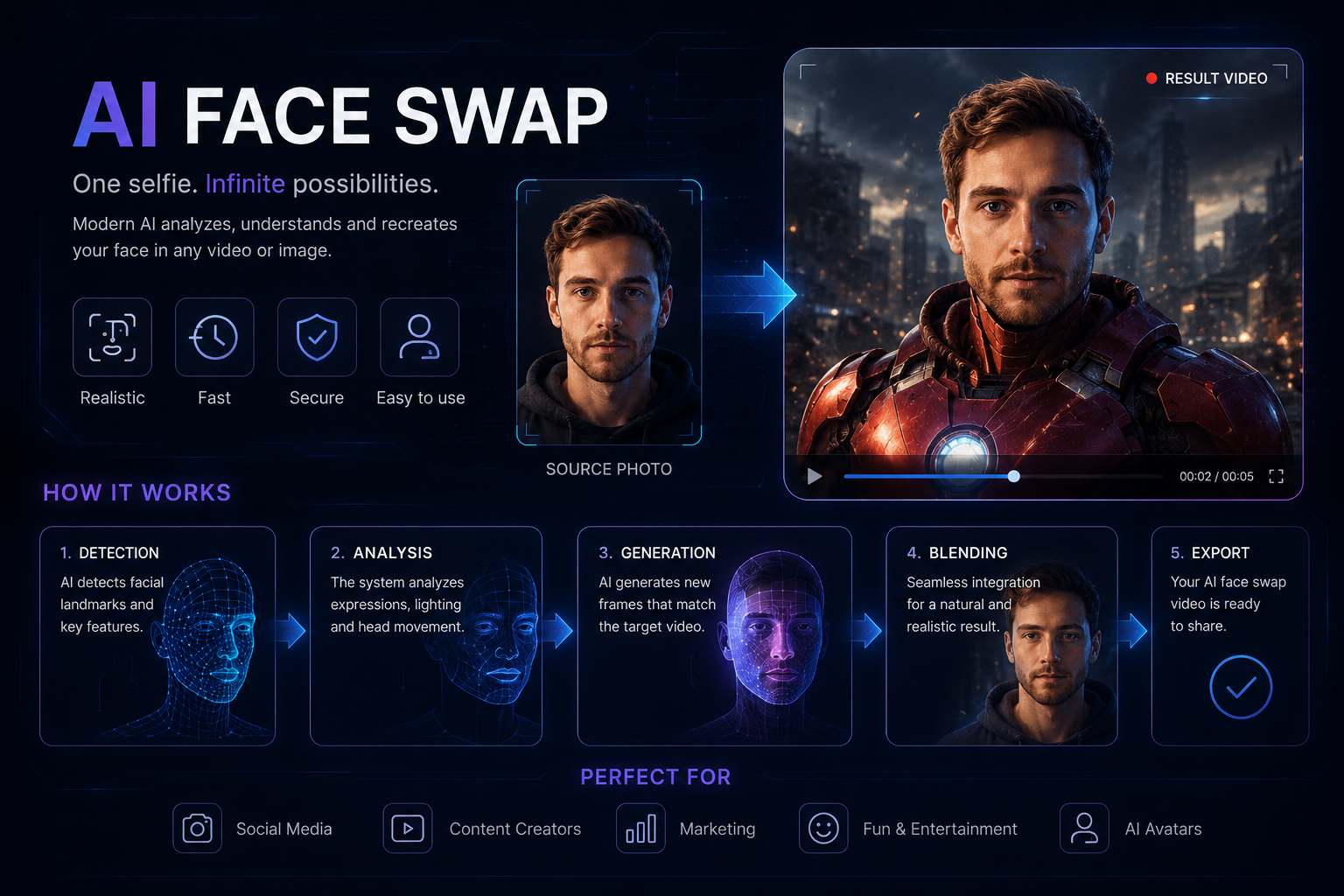
When a Face Can Be Replaced in a Few Minutes
At first, a convincing face replacement can look completely ordinary.
Someone is talking to the camera, smiling and turning their head. The camera moves a little. Nothing in the background seems unusual. If you do not know that the face has been changed, there may be nothing that immediately draws your attention to it.
Then you start watching the face itself.
The eyes are often a good place to look. During a head turn, one eye may sit slightly differently than expected. A smile can reveal a small mismatch around the corners of the mouth. The outline of the cheek or jaw can change in a way that does not quite follow the rest of the head.
Lighting can make the problem even easier to spot. A face photographed beside a bright window and placed into an evening scene already carries a different pattern of highlights and shadows.
That is why face replacement is not simply a matter of cutting out one face and putting it over another image.
The first part of the process is locating the face and estimating its position. Systems such as InsightFace use separate models for detection, recognition and alignment. Its model collection includes RetinaFace and SCRFD for detection, recognition networks, and landmark models that describe the position of important facial points.
The next problem is identity.
A useful way to see it is through SimSwap, a face-swapping method presented at ACM Multimedia in 2020. Its design separates information about the person's identity from information describing the appearance of the face in the target frame. The source image provides the identity, while the target supplies the pose and expression that need to remain in the result.
Consider a simple example.
The source is a front-facing portrait. Both eyes are visible, the nose is unobstructed, and the shape of the jaw is clear. The target video begins with the person looking directly into the camera.
That part is relatively easy.
Then the person turns about 45 degrees.
One side of the face becomes less visible. The apparent shape of the nose changes. One cheek narrows. An ear may disappear from the frame. The source portrait contains no actual photograph of that new view, so the missing information has to be reconstructed.
Expression creates the same kind of problem.
A neutral portrait does not show every position of the lips, eyelids and cheeks. A person may smile, speak, squint or open their mouth in the target video without having done any of those things in the source photograph.
A system therefore cannot simply copy the original pixels. It has to preserve the recognizable characteristics of the source person while generating a face that matches the expression and pose in the target frame.
This is where small defects become noticeable.
The eyes can shift slightly. The jawline can become too smooth. Teeth may look unnaturally uniform. Hair and skin boundaries can become softer than the rest of the image. During a fast head movement, some facial details may disappear for a frame and then return.
Occlusion makes the problem harder.
A hand, strand of hair, pair of glasses or microphone can cover part of the face. In ordinary editing, that means adjusting a mask. In a generative system, the model has to determine which pixels belong to the face and which object is supposed to remain in front of it.
FaceShifter treated this as a separate problem. Its authors describe a two-stage system in which the second stage, HEAR-Net, is used to refine problematic regions after the initial synthesis. The paper specifically focuses on occlusion-aware face swapping and reports handling of regions affected by objects covering the face.
Lighting creates another failure mode.
Imagine a source portrait taken indoors beside a window during the day. The face contains its own highlights, shadows and color temperature. The target video is shot outside at night with a light source coming from one side.
The geometry can be almost perfect and the result can still look wrong.
The reason is simple: the replacement face carries visual information from the source image, while the rest of the scene follows the lighting of the target video. A convincing result therefore requires more than matching the shape of the face.
FaceShifter, for example, was designed to use information from the target image more thoroughly when synthesizing the replacement rather than relying only on the source face.
Older workflows handled these problems manually.
On a photograph, an editor could cut out the face, resize it, adjust the color and blend the edges. With one image, that could be enough.
Video changed the scale of the problem.
The head moves. The expression changes. Hair crosses the forehead. A hand covers the cheek. The camera moves closer. The lighting changes. A mask that fits one frame can be wrong several frames later.
The result is a long list of small corrections.
Modern software hides much of that work. The program can locate the face, estimate its position, follow it through the sequence and generate the replacement. InsightFace, for example, added a dedicated face-swapping model to its Python package and later introduced a desktop interface that includes face-swap trials.
The simple user experience hides the amount of information being processed.
A front-facing selfie can work well when the target video is also mostly frontal. A video with frequent turns, heavy occlusion and difficult lighting gives the system much less reliable information.
When that information is missing, the model has to fill the gaps.
That distinction matters. A neural network is not necessarily recovering a hidden photograph of the person's face from some perfect internal representation. It is generating an image that fits the information available to it. When several solutions are possible, the model produces one that looks plausible according to what it has learned.
That is also why modern face swapping is different from older image editing.
The old approach physically moved part of one image into another.
A generative system can synthesize the facial region again, using the source person's identity together with the pose, expression and surrounding image from the target frame.
The same idea connects face swapping with image-to-video systems.
Once a model can represent a person's appearance and control how that appearance is rendered, a still photograph can become the starting point for a sequence of generated frames. The difficult part is no longer just making one convincing image. The appearance has to remain stable across the sequence.
Otherwise the result can look fine in one frame and subtly different in the next. The nose changes shape. The jawline shifts. The distance between the eyes changes. A few frames later, the face returns to something closer to the original.
A viewer may not identify the exact defect, but the instability is easy to feel.
For creators, the practical applications are fairly straightforward. A visual idea can be tested without another shoot. A personalized greeting can be built from a single photograph. Advertising teams can try several versions of an image before committing to a full production.
The same technology also creates a more difficult problem.
If a person's face can be inserted into a realistic video without their involvement, image editing is no longer the only issue. Consent matters. So does the possibility that viewers will mistake an altered recording for a real one.
The technical improvement therefore has a social consequence: the fewer visible artifacts remain, the fewer reasons a viewer has to question what they are watching.
Eventually, face swapping may stop being something users think about as a separate technology.
The interface can reduce the process to a photograph, a video and a result. Detection, alignment, tracking, identity representation and image generation happen underneath.
The complicated part remains.
It is simply no longer visible to the person pressing the button.